Straight answers about traveling in Turkey, Greece and Egypt, from the people who live, work, and raise their children here.
Our families live here, and our children go to school here. Read our full answer on safety →
Most visitors from North America and Europe find that exchange rates and the lower cost of living make shopping locally fairly inexpensive. Each country has skilled artisans who sell their work at reasonable prices.
Greece's official language is Greek, one of the oldest recorded languages still in use today. Modern Greek comes directly from Ancient Greek, the language of philosophers, poets, and much of the New Testament. Over 10 million people speak Greek as their first language, mostly in Greece and Cyprus.
Egypt's official language is Arabic, specifically Egyptian Arabic, the most widely spoken dialect in the Arab world. Rooted in Classical Arabic and shaped by Egypt's long history, it's the everyday language of over 100 million Egyptians. Many Egyptians also have a working knowledge of English or French, especially in the big cities.
Turkey has its own language, Turkish. Descended from Ottoman Turkish, it has a 1,000+ year history and is related to languages spoken across Eastern Europe and North and Central Asia. Roughly 80 million people speak Turkish as their mother tongue.
At the moment, US travelers can visit Turkey and Greece visa-free, and Egypt offers a visa on arrival. These rules can change, so please check the current requirements for your passport before you travel.
In a word, delicious.
Greek food is fresh, simple, and full of flavor: grilled meats, seafood, salads, olives, feta, and plenty of olive oil. Local tavernas cook with the seasons and the sea, usually with warm bread and a splash of house wine. Every bite tastes of centuries of tradition and hospitality.
Egyptian food is built on staples like lentils, rice, grilled meats, and fresh bread, along with dishes like koshari and ful medames. Dates, figs, eggplant and okra come and go with the seasons. A meal here is as much about the company as the food.
Turkish food includes beef, chicken, fish, and plenty of vegetarian dishes. Fruit and vegetables come straight from local farms: olives, pistachios, hazelnuts, cauliflower, okra, spinach, grapes, oranges, tea, and much more. The hard part is choosing which dish to pair with which local wine from the fertile Aegean coast.
Is Turkey part of the Middle East? It's hard to say. Turkey sits where the Balkans, the Caucasus, the Middle East, and the eastern Mediterranean meet, and the country (and Istanbul itself) spans Europe and Asia. Some go by geography and call it the Middle East. Others go by language and culture and call it Europe or Asia. Turks tend to enjoy not quite fitting anyone's list. As the remnant of the Ottoman Empire, with a heritage going back much farther, Turkey is best described on its own terms.
Is Egypt part of the Middle East? Again, it depends who you ask. Geographically, Egypt is in North Africa, with the Sinai Peninsula linking it to the Middle East. Culturally and politically, it's often grouped with the Middle East because of its language, its Islamic heritage, and its regional alliances. Egypt has long been a crossroads of Africa, Asia, and the Mediterranean, and it's home to one of the world's oldest civilizations.
Tour prices on the site are land only; airfare is separate. The single supplement varies by tour and is listed on each tour page.
Yes. There's no minimum group size, and every tour we run is private, so a tour for two is simply a smaller one: your dates, your pace, the same licensed guides. As a guide, a couple on the Seven Churches tour is about $7,500 for both, land only, plus airfare.
Our families live here. Our children go to school here. Kieler has lived in Izmir, ancient Smyrna, since 2016, and we've run tours since 2021. We'd rather lose the booking than take a group somewhere we wouldn't take our own family.
Our founder lives in Izmir, ancient Smyrna, where he's raising his family, and we've run tours since 2021. Our guides and staff live here too, so we're watching conditions every day, not from a distance. We stay in direct contact with the US Consulate General, and we've restructured trips as late as 24 hours beforehand when it was wise.
On the trip you're never on your own: you'll have your guide's direct line, the hotel front desk can reach your guide at any hour, and our team is on WhatsApp for the whole tour. Start by reading the current US State Department advisory for each country, and ask us anything. The simplest rule we keep is this: we won't take your group anywhere we wouldn't take our own families.
“…it was the support we got after testing positive for Covid that was impressive. Enjoy Tours arranged for our extended stay at the hotel, coordinated our health care and continued testing, and took care of all our travel arrangements after we were cleared to fly. In our time of crisis, they had our back.”
Glen L.
For most groups the real risks of a study tour are ordinary ones: heat, uneven stone, long days, and the bus. We would rather tell you that plainly than let you discover it on day two.
We recommend bottled water, because of the high mineral content of the tap water, not because of any risk of disease. Washing your hands and brushing your teeth at the sink is fine.
On the street, people dress much as they do in any Western country. The farther east you travel, the more conservatively you'll want to dress. In Eastern Turkey, for example, it's wise to wear pants rather than shorts, and shirts that cover the shoulders. Dress the same way when visiting mosques and other places of worship. Bring a hat, sunglasses, sunscreen and sturdy walking shoes.
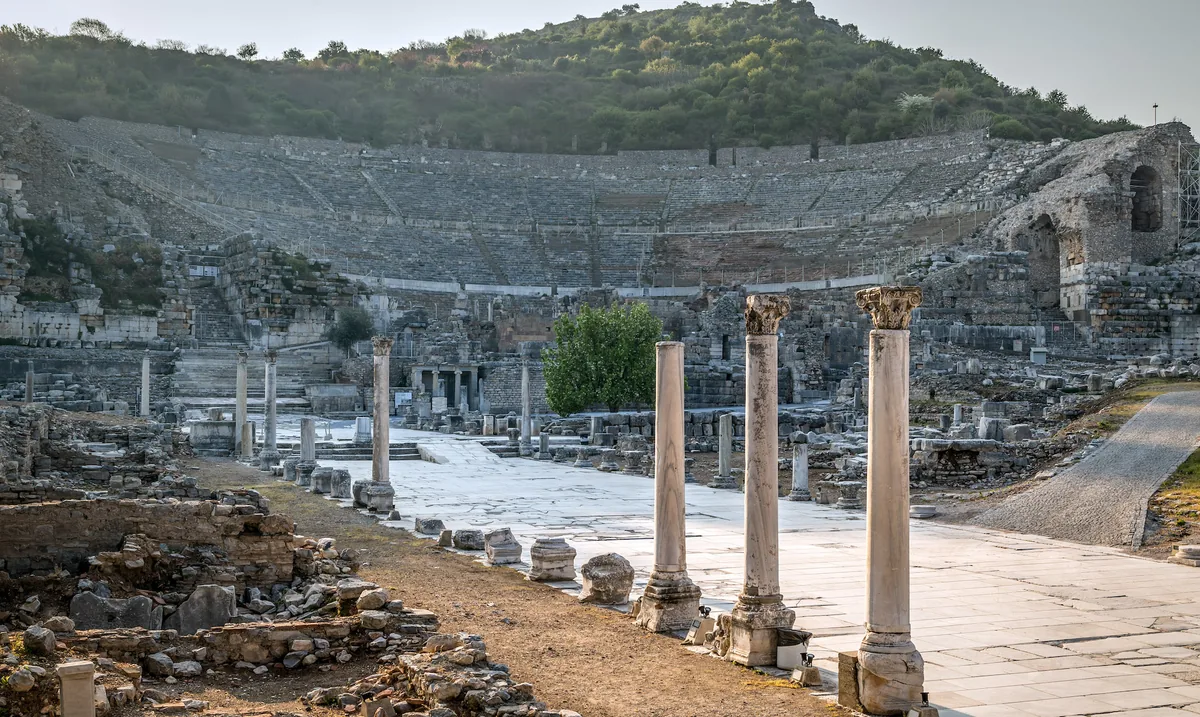
15,000 steps a day is common. Surfaces include marble, packed earth, steps, slopes. To give two examples: Ephesus is about 15,000 steps on uneven, sloping ground, with bathrooms at either end of the site. Pergamum is about 5,000 steps, uneven but largely flat, with bathrooms on site. Winters get down to freezing, summers can reach 100-degree heat, and spring and fall are generally mild. Most sites have limited shade, and we take that into account in our tour times and routes, especially in summer.
We have hosted those with limited mobility and wheelchairs. While some parts of some sites won’t be accessible, a slower pace and accessible sites are available.
Guests in their 70s have joined dozens of our trips. The days involve real walking (see above), so tell us about your group and we'll plan the pace with you.
Travelers on our set routes and on the Mack Stiles trip need to be 12 or older. Younger children are welcome on private family trips; ask us for details. The pace suits ages from about 13 to 72, with real walking and summer heat (see “How much walking is there?” above). The Mack Stiles trip is our fullest itinerary.
Every traveler under 18 travels with an adult aged 25 or older (a parent, legal guardian, grandparent or other named adult) and rooms with that adult or with siblings. A minor traveling without a parent carries a notarized consent letter from each parent who isn’t traveling.
You are coming to study the places where Scripture happened and to meet the church that lives here now. If your tour includes a Sunday, we can look into joining an English-speaking congregation for worship. This is usually only feasible for smaller groups, so ask us early.
Groups are most welcome to pray aloud, read and discuss Scripture on site, and carry Bibles or other materials that may be helpful to them. We ask that groups do not distribute materials to the public while on tour.
We have medical care facilities accessible throughout the country, and we will provide transit services whenever necessary. There are also a number of medicines available over the counter, including many medications that need a prescription in the United States.
Each traveler can pay Enjoy Tours directly, or we can bill your church or school for the whole group. A $250 deposit secures the trip, and full payment is due 90 days before departure.
Your price is based on the group size agreed in your proposal, and we can agree a minimum number at that stage. If numbers drop from the initial agreement, the price may change accordingly.
There’s no youth price: everyone 12 and up pays the tour price. Two teens can share a twin room, and a parent with two or three teens can share a triple, at the normal per-person price; the third bed may be a rollaway or sofa bed. Triple, quad and family rooms are on request and not guaranteed. A teen in their own room pays the single supplement.
On Paul’s Footsteps in Turkey and Paul’s Footsteps in Greece only, a 12–17-year-old sharing a triple with parents gets $250 off once the hotel confirms a cheaper third bed.
Prices assume about 15 travelers; for a private family group of 6–10 we quote your group’s own price, usually 5–10% more per person.
Often, yes, subject to availability. Teachers come to us through trusted relationships. In the past they've come from The Gospel Coalition, The Southern Baptist Theological Seminary and 9Marks, along with other like-minded churches and institutions. Many groups bring their own pastor or professor, and we build time for teaching into the day.
Bible tours and custom journeys through the lands of Scripture.