
Nicea Conference

A summary of the session
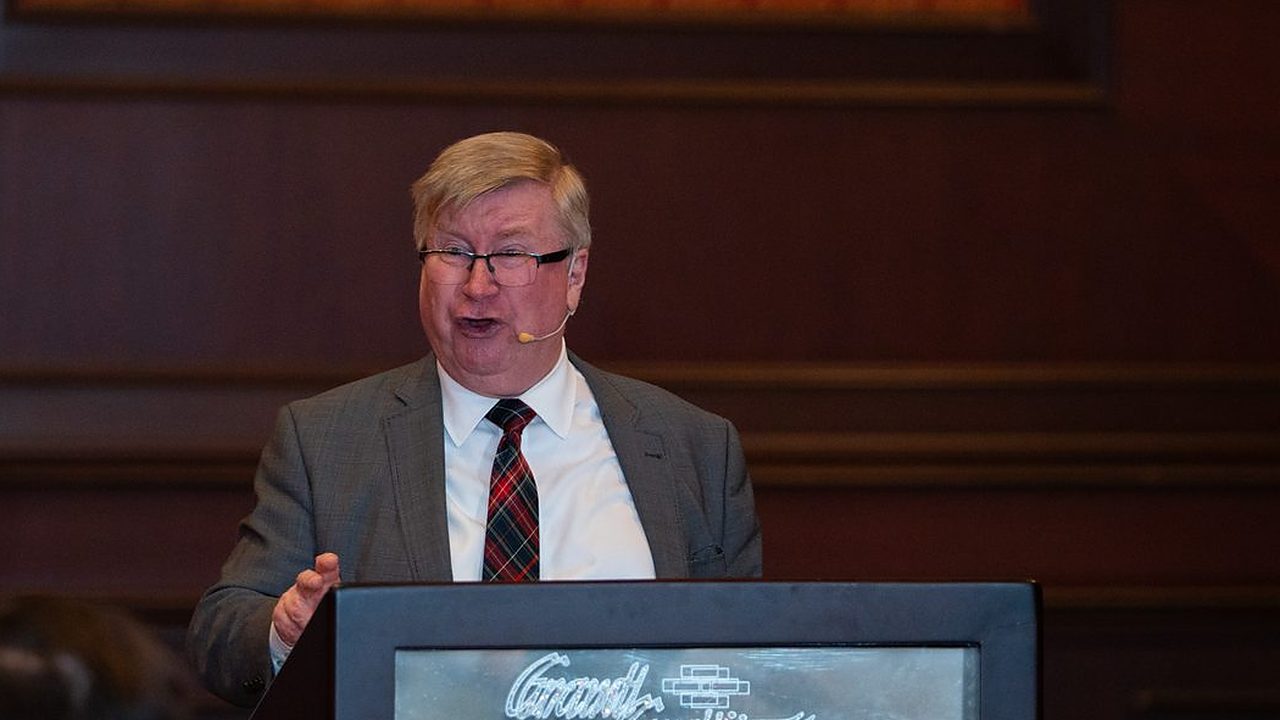
Mark Thompson focuses on a short phrase at the center of the Creed: according to the Scriptures. This breakout session looks at how the written Word and the church's confession relate, with the creed standing under Scripture and not over it.
Transcript
Mark Thompson, “According to the Scriptures,” breakout session, Nicea Conference 2025, Istanbul.
Opening prayer
Heavenly Father, we want to thank you for the Lord Jesus. Thank you for our salvation in him. Thank you for who he is, your beloved Son. And thank you for the Council of Nicaea and the way in which we have been encouraged by its confession of him in that way. And we pray now as we think about that a bit more that you might grant to us such an understanding of you and of what you have done and what you have given us as resources in our world now to live as your people that you might be honored by our lives.
A council that shaped the church
And we ask it in Jesus’ name. Amen. Well, the Council of Nicaea is without doubt a landmark in Christian history. Can’t say that about every council or committee. Can’t even really say that about every ecumenical council. But you must say it about this one.
The Scottish theologian T. F. Torrance once described the council, or more particularly the use of the expression one being with the Father, as a decisive step in deeper understanding of the gospel. An irreversible event in the history of Christian theology.
Now, such a view is one of a long perspective, that’s true. We’ll have to come back to whether everyone at the time saw it that way a little later. What Torrance meant though was that the use of this phrase, just one word in Greek, homoousion, explained the Bible’s teaching on who Jesus is in such a way that once you’ve heard it and understood it you can never retreat from it without abandoning the faith.
Unless you are prepared to confess with the creed that the Son is one being with the Father as much God as the Father is then you’ve stepped away from the witness of the New Testament. Witness like the word was in the beginning with God and the word was God, John 1. I and the Father are one, John 10.
To see me is to see the Father, John 14. All the fullness of God dwelt within him, Colossians 1. He did not count equality with God a thing to be grasped, Philippians 2. And the glory that I had with you before the world existed in John 17.
Yet it is quite certain that none of the 318 bishops who gathered at the summons of the emperor that year, if that’s the right number, and if the emperor was the one who summons them, and historians debate both of those questions.
None of them believed that they were introducing any novelty into Christian discussion. They were convinced they were defending the faith taught in Scripture against the innovations of others that threatened to undermine both the Christian confession of God and the Christian understanding of salvation.
Biblicism or theological retrieval?
So, how do we especially those of us who are Protestants with a high view of the Bible as uniquely the word of the living God standing above all other words how do we how should we treat the creed?
The question concerns more than just the creed, of course. It plays into the broader questions about the role of the great theological tradition, which has become a fascination in some circles of late. Some protest that they’re tired of the vapid, insipid, superficial versions of Christianity they’ve experienced and are now pursuing a deeper, more engaging variety through sustained attention to the giants of the past, the church fathers, the reformers of the 16th century and their immediate heirs, the ecumenical creeds, and the reformed confessions.
It’s sometimes cast as a battle between biblicism versus theological retrieval. A naive literalistic appeal to no creed but the Bible with lots of proof texting versus a measured appreciation of gems to be found scattered through the entire history of Christian thought.
But, as has recently been pointed out, this is a well-worn track. Two centuries ago, it was traversed by John Henry Newman, who started out as an evangelical Christian in Oxford. Later seeking a deeper historical rootedness as a Christian, he converted to Roman Catholicism, was in time made a cardinal, and only very recently was declared to be a doctor of the church by Pope Leo the 14th. Provocatively, Newman once wrote, “To be deep in history is to cease to be a Protestant.”
But, is that true? It’s worth recognizing the legitimate concerns of theological retrieval. Some of the rhetoric on the part of those defending the primacy of the Bible in recent years has been a little overblown and too quickly dismissive of historical and systematic theology. We can too easily reflect the Spirit of our age with its fixation on the present and the privileging of what is most recent, spontaneous, creative, or innovative. And the result has not always been edifying.
A deeply ingrained Western individualism is strangely affirmed. A friend of mine keeps saying that the Bible writers are the only theologians or at least the only theologians we need and there’s a little bit of difference between those two things.
So it’s just us and the Bible or even just me and the Bible. Yet he still uses commentaries when he’s preparing his sermons. He still from time to time recites the creeds and he signed off on the 39 articles of religion when he was ordained. So as much as he might rage against history or more specifically historical and systematic theology he can’t escape it. We need church history because the word of God is spoken into the realities of history and especially the history of the church. We live and our proclamation of Christ takes place within the space-time continuum as we’ve been reminded. Neither the gospel nor ourselves are abstract or ethereal but they are real, concrete and physical.
And historical theology a particular subset of church history reminds us of that. The Bible is uniquely the written word of the living God. God breathed uniquely inerrant and infallible sufficient and all the rest but it does not operate in a vacuum in the world. Most importantly I’m not the first one to read the Bible or to wrestle with its teaching on any particular point. And it would be arrogant of me to simply ignore those who have read it before me or those who are reading it alongside of me.
We can learn from each other. Even from those with whom, at least on some things, we disagree. So, taking seriously Augustine or Luther or Owen or even Barth does not mean we have to become them or endorse everything they have to say or everything that they have done. But the sovereign Lord has given us each other with all our flaws and limitations, and he has gifted the church with apostles, prophets, evangelists, and pastor-teachers that we might together be equipped for the work of ministry, built as the body of Christ, and attain the unity of the faith and the knowledge of the Son of God.
So, theological retrieval is not in itself a bad thing. It is, as one evangelical theologian put it, a mode of doing theology by which we look back creatively in order to move forward faithfully. Put another way, it’s just a matter of taking seriously the communion of saints. And when we do and when we’re willing to go back further than just the last century or so, we discover a more celebratory style of theological writing. And we find ourselves in a better position to ensure the proportions of an overall account of Christian teaching are not governed by circumstances but by the object of Christian doctrine, that is God and the economy of God’s grace. And those last words belong to John Webster.
We have a deep and rich heritage as Christians. I’m sure you know that. And not to draw upon it is to be impoverished. But the danger is that in drawing on it or in the way we draw on it either a crucial distinction between the God-breathed authoritative Scriptures and those other writings is blurred or the Bible is pushed into the background identifiable only by those who know it well and so can pick up the allusions.
Sometimes, in the most extreme cases, the Bible is ignored altogether. The two-millennia-long conversation about God and his involvement in the world he created and redeemed is transformed into a discussion more about our conversation partners than about the topic of the conversation. A variation of that last problem is thinking that all we need for good theology is the identification and repudiation of an error in the past.
Full and sustained attention needs always to be given to the word that God has spoken given to us as the God-breathed Scriptures. And that must include their trajectory to Jesus Christ, the incarnate Son, who stands at the center of God’s purposes and is his perfect self-revelation.
But because what God has to say is always more important than what I have to say or for that matter, what Calvin or Augustine or the Nicene Fathers had to say the words of Scripture ought not only to be prominent and easily identifiable they should shape and discipline what I have to say. And the point I’m laboring is that the creeds and confessions, including the Nicene Creed along with the contributions of theologians throughout the last 2,000 years, serve that indispensable task and must never replace it.
So, we can honor the creeds and uphold the final authority and sufficiency of Scripture, sola scriptura. The authority of the creeds is, as we’ve heard several times over the last couple of days, a derived authority. They always remain subject to the higher and decisive authority of the words of the Bible. But, their authority is no less real for being derived and subject to another authority. That is a concept itself well understood in the history of thought, as we heard again and again we’ve been told about the norma normans the Scripture that is not ruled or normed or governed by any other authority, but which governs all other authorities, and the norma norma normata, secondary authorities, which are under that primary authority, but which nevertheless are not despised, lightly treated, or ignored, since they do have a genuine authority of their own.
The creed, as a key component in the great theological tradition, serves the church in the church’s primary responsibility to align its witness to the word in the world, both to the word of God, in its words and in its deeds, so that it might make known to the rulers and authorities in the heavenly places the manifold wisdom of God.
Good and necessary consequence
Now, almost 30 years ago now, an American reformed theologian John Frame wrote this. Theological proposals must be accountable to Scripture in a specific way. It is not enough for theologians to claim that an idea is biblical. They must be prepared to show in Scripture where that idea can be found.
The idea may be based on a general principle rather than a specific text, but a principle is not general unless it is first particular, unless that principle can be shown to be exemplified in particular texts. So, a theology worth its salt must always be prepared to show specifically where in Scripture its ideas come from.
And showing that always boils down, in the final analysis, to citations of particular texts. This is why, for all that can be said about the abuses of proof texting, proof texts have played such a large role in the history of Protestant thought, and there is something very right about that.
The Spirit and the word
But, you might be asking, have I ignored the ongoing role of the Holy Spirit in guiding, directing, and leading the church into all truth? Can we see the creeds as the result of the Spirit’s work, and so bearing the authority of God more directly than I’ve been suggesting in the last few minutes?
Leave aside for the moment the context of Jesus’ original promise in John 16, which I believe is first and foremost fulfilled in the preaching and writing ministry of the apostles. There is ample evidence in the New Testament that God is active today by his Spirit as he directs all things, and in particular the church of his redeemed people, to the end he has appointed for them. God is present with his people, always present with his people.
Nothing is done in his absence or behind his back. Christ rules his church by his word and through his spirit. The Spirit unites believers to Christ, Ephesians 2, enables them to confess him as Lord, 1 Corinthians 12, and to join him in addressing God as Abba Father, Romans 8.
What’s more, the Spirit and the word are inseparable. By his work, the prophets were moved to write, 2 Peter 1, and as the breath of God, he ensures that the final product, the all Scripture, is the God-breathed Scripture.
Those who belong to Christ are led by the Spirit, Romans 8, but that does not mean being led beyond the Scriptures as if the Scriptures were insufficient or somehow needed to be supplemented. What would that say about God?
The Spirit leads Christ’s people into deeper and deeper engagement with the Scriptures as the word of Christ. So, the Apostle Paul wanted the Corinthians to learn not to go beyond what is written, 2 Corinthians 4. The Spirit’s work in the church draws Christ’s people into a common mind and mission that takes its strength and authority not from some new word, but from the commission they’ve already received from Jesus, Matthew 28.
So, in the end I’m convinced the pitting of biblicism against theological retrieval is both contrived and unhelpful. Augustine, widely considered the greatest theologian of the early church, was explicit in affirming the unquestionable authority of what he called the sacred canon of Scripture, both Old and New Testament, contained within its own established limits, and to be preferred to all later letters of bishops, whether one bishop, 318 bishops, or even more. And he clearly included that those in that. Martin Luther, father of the Reformation, first and foremost a preacher, lecturer, and scholar in biblical studies, and champion of Sola Scriptura, remember the diet of worms, my conscience is captive to the word of God, he recalled his reaction upon discovering the meaning of righteousness in Romans 1. He rushed to the university library to see whether anyone had observed this in the text before him.
We can and must maintain the unique authority of the Scriptures while at the same time engaging in healthy theological retrieval. And some serious attention to the Nicene Creed is indeed part of that. So, back to the Nicene Creed itself.
Is the creed biblical?
Since this is the 1700th anniversary of AD 325 and not AD 381, I’ll confine myself to the original 325 version of the Creed and more especially to its teaching about the Son and his relation to the Father. And if you’ve got the sheet that I left around, that’s setting that out for us and we’ll come back to that in a moment.
And the big question to ask is the Creed biblical? Well, there seems to be sufficient evidence that Athanasius was present at the Council of Nicaea providing some kind of secretarial help to his bishop Alexander of Alexandria. And Arius, the protagonist at the heart of the dispute, who like Athanasius was not a bishop, could also only be present as an aid to the bishop who led his side of the argument, Eusebius of Nicomedia.
So, if that’s true and Athanasius was there, Athanasius’ account of what actually went on in his defense of the Nicene definition is worth taking seriously. It seems entirely reasonable that he might have been directly involved in drafting the text of the conciliar statement. And in his account, he seems to suggest that there were a number of drafts of the creed, the first of which seems to have attempted to counter the expressions used by Eusebius and Arius with the acknowledged words of the Scriptures. Mark Smith from Cambridge describes what was going on at the beginning as a sort of exegetical workshop.
That’s a very important piece of information since it does away with the charge that from the beginning the creed was being influenced more by Greek philosophy than from Scripture, the so-called Hellenization thesis. We can tell from what Athanasius says that Alexander and Athanasius wanted to make a statement that explicitly reflected the teaching of Scripture.
So, countering the Arian suggestion that the Son was created from nothing, with its emphasis on created, of course, Alexander used the language of John 6:46. He’s not from nothing, he is from God. The problem was that Arius and Eusebius could easily agree with that, too.
After all, everything comes from God according to Paul in 1 Corinthians 8. So, the Son could come from God and still be a creature, they argued. Athanasius explained how that drove Alexander and his comrades to be even more precise. These are his words. But the fathers, perceiving their craft and the cunning of their irreligion, were forced to express more distinctly the sense of the words from God.
Accordingly, they wrote from the essence of God. In order that from God might not be considered common and equal in the Son and in things that have a beginning, but that all others might be acknowledged as creatures and the Word alone as from the Father.
For though all things be said to be from God, yet this is not in the sense in which the Son is said to be from him. Alexander’s team, you see, were forced not simply to repeat the exact words of Scripture, but to explain what those words mean.
In that way, we can see that they were not intending to add to the Scripture at all, but rather to burrow further into it. The relation of the Son to the Father is not the same as that from the that of the created universe to the Father or any individual being within it to the Father. It’s a unique relation.
One that goes as deep as the very being of God. And that’s why the idea of an exegetical workshop is such a helpful way of describing what was happening. It was not enough simply to cite or quote biblical texts. Those texts needed to be understood in context, compared with other texts on the same topic, and in short, exegeted. It was not that the biblical text cited could legitimately go either way, that they were ambiguous or something like that. Rather, they needed to be better understood both in terms of their particular context and the canonical biblical theology, but also in terms of what the actual words were saying in those contexts.
And it soon became apparent that in order to do that, other language not itself found in the Bible, might need to be employed. So, in order to defend the teaching of Scripture, that is the intended meaning of the words used by the biblical authors under God’s inspiration, the Nicene bishops felt compelled to use words that were not themselves found in Scripture. And that raised eyebrows from the beginning. Over the next few decades, men like Athanasius found they had to answer doubts about the creed precisely for this reason. His defense was that the sense of Scripture was not just maintained, but protected by the use of the language the council had adopted. His words, “Even if the expressions are not in so many words in the Scriptures, they contain the sense of the Scriptures.” He continued, “The bishops were again compelled on their part to collect the sense of the Scriptures and to resay and rewrite what they’d said before more distinctly, namely, that the Son is one in essence with the Father by way of signifying that the Son was from the Father and not merely like, but the same in likeness.”
What Alexander and Athanasius and others saw as the mishandling and misrepresentation of the Bible’s words by Arius and his friends needed to be countered by pointing to the true meaning of those words in their context. They had to find a way of explaining their meaning that would not simply be redefined and appropriated by Eusebius and Arius. And that is why in 325 the Creed read uniquely begotten of the Father, that is from the being of the Father.
And a little further down, one being with the Father. Not just from the Father in some ambiguous way, but from his being. Not of another being, not of a similar being, but the same being. And the choice of this way of speaking clarified things enormously.
It affirmed in the strongest possible way unity between the Father and the Son at the level of being, not simply at the level of will. At the level of being, not just that they agreed and were perfectly in line with each other’s purpose.
And it was one way of speaking that Eusebius and Arius had made perfectly clear they were never going to accept. So, because the Arian bishops had found it so easy to twist whatever biblical passages were put in front of them, the non-scriptural word homoousios became the only viable option precisely to defend the witnesses of Scripture.
So, to quote again from Mark Smith’s very helpful little article called Nicaea then and now, “Critically, the point of this non-scriptural terminology was not to go beyond Scripture or to replace it, but rather to secure the majesty of the biblical witness against those who would, precisely through a false and disingenuous appeal to mere biblicism, pervert and diminish it.”
How the creed uses Scripture
The Nicene Creed did not cite biblical passages as it made each statement about the Son as so many modern doctrinal statements do. The only way you could actually do that in the early church, long before Stephen Langton’s chapter divisions came into being or the later divisions into verses in the 16th century, was to quote the actual words of the biblical text, and that would have made the statement unwieldy. And I think it would have not served the original purpose of the Creed. More of that in a minute. However, it’s not at all difficult to demonstrate that each line of the Creed composed in 325 is anchored in the words of the New Testament, which is where that sheet I’ve handed you comes into its own. What I’ve put on the top box is the Creed from 325, just this portion of it to do with Christ, and then look at biblical verses, and then look at what it was saying.
So, Jesus Christ is our one Lord, not one Lord amongst many. An affirmation made throughout the New Testament, but we might look particularly at Romans 10 or 1 Corinthians 8 or 1 Corinthians 12 or Philippians 2. He is the Son of God, not simply in the way the Messiah could call be called the Son of God in the Old Testament, but in a much richer sense as the divine Son of the Father, a deep and eternal relationship.
We could see those occasions in which Jesus speaks of the Son without any other qualification and the Father. Romans John 3:16, Matthew 11:27, and the Great Commission in Matthew 28. He is uniquely begotten of the Father. That is from the being of the Father. Their relation, as I said, is not just a matter of will, but a matter of being. I and the Father are one, Jesus said in John 10. The word was God in John 1.
He is God from God. Not something less than God, nor something just derived from God. This affirmation reflects the introduction to John’s gospel. The word was with God and the word was God. He is light from light. He brings the light of life and makes known the Father. He is true God from true God, not a second or lesser God. 1 Thessalonians 1, John 17. He is begotten, not made. Not a creature, not part of the creation in eternity, but on the God side of the creator-creature distinction, that most basic distinction in the entire universe. He’s on the God side of that. God, everything else. That’s where the Christ is. That’s where Jesus is.
That’s where the Son is. He is one being with the Father. In the most profound sense, he is God. As much God as the Father is. Again, John 1, Philippians 2, John 10, and other places. You see, at every point, when speaking about the Son in whom we believe, the creed was shaped and disciplined by Scripture. It is biblical in that most basic sense.
It’s not trying to say more than the Bible says about the Son. It’s trying to be faithful in confessing what it does say about the Son. So then, how should we treat the creed? It’s a well-known fact of history that producing and signing the creed did not end the debate that led to the council. The 4th century was overshadowed by continuing conflict over the issue.
A costly confession
And some of it was quite violent. Athanasius, who not too long after the council succeeded Alexander as the bishop and patriarch of Alexandria, was exiled five times, and his was life was definitely in danger. At one particular point, the stories maybe apocryphal, but the story is a good one. His servant is said to have come into his room and said, “Athanasius, don’t you realize the whole world is against you?” And Athanasius is said to have replied, “Well, then it’s Athanasius against the world.” And if he didn’t actually say that, he acted as if he did.
So at points his life was seriously under threat. Other bishops were writing against him and encouraging the emperor to act against him. And what’s more, for the first two decades after the council, the creed itself was hardly mentioned in correspondence. How do we account for that? Well, in hindsight, the reason’s obvious. Here was a document that few, if any, wanted to remember.
Perhaps the heavy hand of the emperor at the council had something to do with that. The bishops had been told that they would not be allowed to leave until they’d signed the document. All but two of them did, and those two were swiftly deposed and excommunicated. So, it’s very easy to guess that not all who signed the document that day were 100% sold on what it said, at least not yet.
The creed today
But today, in many churches all over the world, these words, or the version of them reaffirmed at AD 381 with a little bit of modification, and again at Chalcedon in 451 with a little bit more modification, are recited by Christians as a confession of true orthodox faith.
And I think that would have come as somewhat of a surprise to the bishops who gathered at Nicaea 1,700 years ago. They had not gathered to produce a piece of Christian liturgy. I do not think they believed they’d come together to produce a summary of the Christian faith, either.
If so, they left a great deal out. Nothing is said about being justified. Very little was said about the Holy Spirit. Simply, we believe in the Holy Spirit. Nothing about human sinfulness or the need for faith, or the church, or the place and meaning of baptism and the Lord’s Supper. But they weren’t trying to write about everything, even in summary form.
I don’t even think the Creed was intended as an interpretive grid for understanding Scripture, as some people suggest. That would always run the risk of placing the grid alongside or above Scripture. Instead, it was intended originally as a rather focused and circumscribed test of orthodoxy for bishops who were wavering about one of the central truths of the Christian faith. Whether or not Jesus is as much God as the Father is.
But he has to be. He has to be that because that is how he could save us. The whole creation is marred by sin and needs a savior. And that would have been true of him, too, if he was only a creature, however exalted, and not truly God. Jesus Christ is not a mere example of obedience that we can follow, as Arius suggested. No, he is God the savior who brings out into the open the compassionate and righteous character of the Father. And that is why he’s worshipped.
It’s a right good and delightful thing to celebrate the Council of Nicaea and the confession of biblical faith that it produced. Many of us have been richly blessed by joining in its confession regularly in our churches, deeply conscious of our fellowship with 17 centuries of believers. And that’s how I think we should understand the continued place of the life of the creed in the life of the churches, an opportunity to join our confession on critically important matters with those who’ve gone before us, without pretending for a moment that there’s not more to say. We stand together as those redeemed by Christ, the unique Son of God, of one being with the Father, as those who belong to him.
English theologian John Webster was right to remind us that creeds and confessions have no free-standing existence. They are not a replacement for or supplementation of or improvement upon Holy Scripture. They are not even a non-negotiable normative reading of Scripture.
But that does not render them of no value at all. This creed has stood the test of 1,700 years as a faithful confession of some of the central truths of Scripture and so of the Christian gospel. And may we be found still confessing those truths on the day when our Savior returns to take us home. Because these are the truths that are taught to us in his word, in God’s word, and it’s because of God’s word primarily before the creed that we believe them. So, why don’t we pray that we might stay faithful and confess these truths until our dying days.
Closing prayer
Heavenly Father, we do thank you for the Creed of Nicaea. We thank you for the courage and the clarity of men like Alexander and Athanasius who heard and saw what was being done with your word by others and sought not to add to your word, but to dig deeper into it and expose exactly what it was saying. We thank you that your word sufficiently testifies to the character and the nature of your son.
And it is because your word is written on our hearts that we confess him as your son, our Lord. Please, by your spirit, continue to make that true and work in us so that our lives, as well as our words, confess these truths. And we ask that in Jesus’ name. Amen.
Now, thank you.
I think
Keep going
More sessions






