
Nicea Conference


A summary of the session
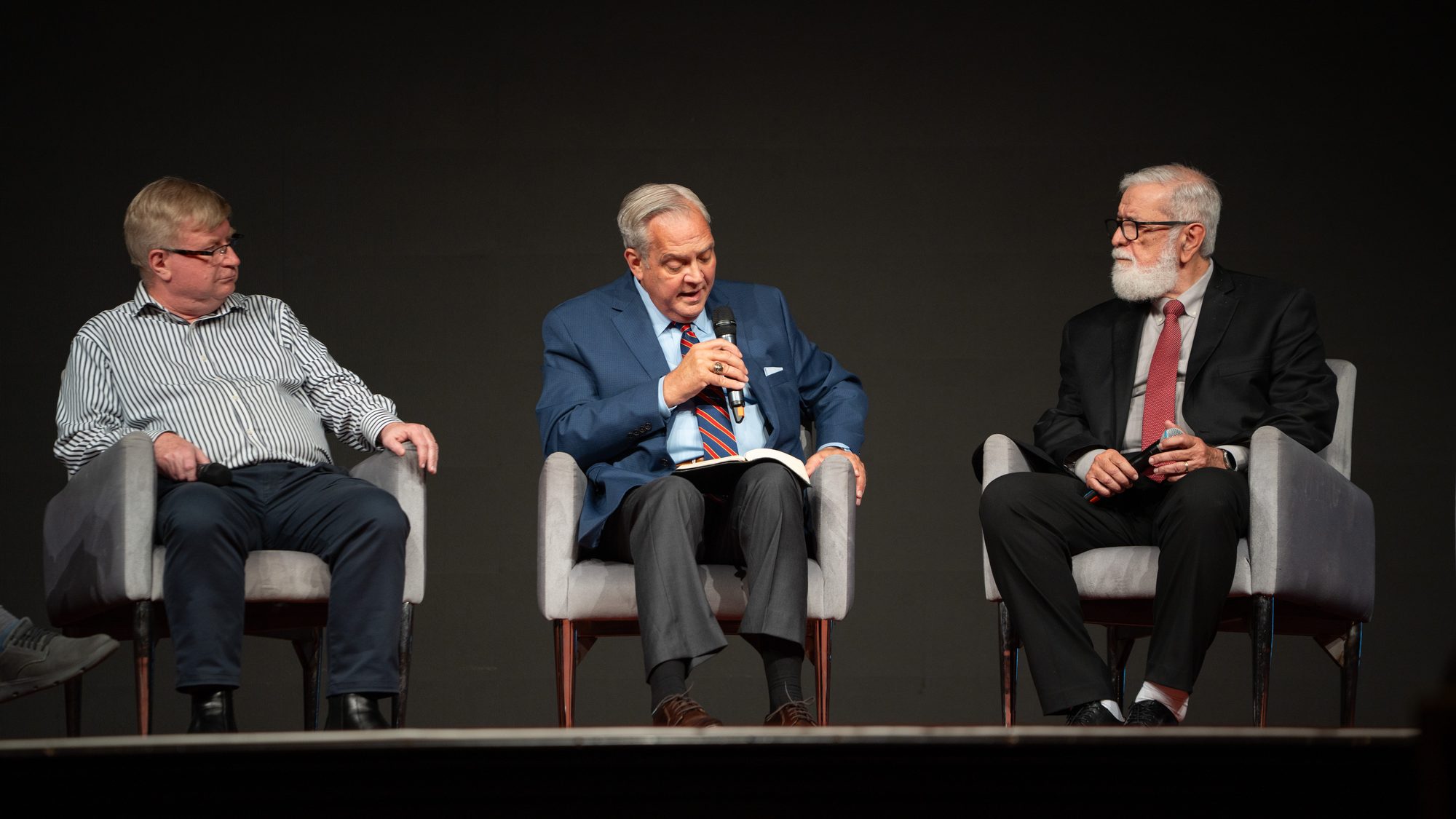
A panel with Leonardo De Chirico, Mark Thompson, Albert Mohler, and Augustus Nicodemus Lopes on the heresies the church faces today. The conversation asks why the language the church settled on in the fourth century still does its work now.
Transcript
Panel discussion, “Facing modern heresies,” with De Chirico, Thompson, Mohler and Lopes, Nicea Conference 2025, Istanbul. Speakers aren’t labelled in the source captions.
Introductions
Welcome, brothers. We’re going to talk now about modern heresies. Before we do that, I w would love if you would just say your name, where you live. And we’ll come back to that a little bit too, but maybe in what position that you’re currently serving right now. I’ll go first as the moderator. Scott Logsdon. I live here in Istanbul, Turkey and I serve as the senior pastor of the Union Church of Istanbul. Okay. I’m Augustus Lopes. I’m from Brazil living in Orlando right now where I serve as assistant pastor of Esperança Bible Presbyterian Church.
I’m Albert Mohler from Louisville, Kentucky, and I’m president of the Southern Baptist Theological Seminary.
And I’m Mark Thompson. I’m from Sydney, Australia, and I’m the principal of Moore Theological College.
And I am Leonardo De Chirico. I’m a pastor in Rome as well as director of the Reformation Initiative. So brothers te tell me your denominational background. Augustus
I am Presbyterian.
Is that like an official thing with Presbyterian? I didn’t know that. Al,
I’m a Baptist. This means immersing in water.
There we go.
I’m really curious how this is going to go. I didn’t realize this was going with hand motions. But next, our Anglican brother, Mark.
I’m trying to work out what to do with Anglicanism,
except to say that we’re very familiar with heresy.
Be careful there. He might agree. And Leo,
I’m reform Baptist. Baptist.
Error and heresy
Okay. So you all are coming from four different continents and from different denominational backgrounds. Three different denominational backgrounds. And I’m curious as we talk about modern heresies before we even get into modern heresies I’m curious is there a difference between error and heresy and this is for each of you. So if each of you could kind of answer that’d be wonderful.
I think there must be a difference between error and heresy. Otherwise I’m a heretic sitting next to a number of people who will be involved in baptism immersion. I was baptized as an infant with aspersion.
Now that you might consider that to be wrong. I hope you don’t think that means I’m a heretic. I think that’s a distinction. I was at a conference quite a few years ago now where a man was speaking and he was being berated by in the question time by somebody continually calling him a heretic and he said at the end of it you know I might not be a heretic I might just be wrong and I that that helped me to see a distinction between error and heresy which I would flesh out in terms of how close the error is to undermining Christ and the salvation he brings.
Okay, Leo, how would you what would you add to that, Leo?
Yeah, I would agree with Dr. Thompson. I will also add that a more serious problem comes up when the church defines as a doctrine something as a dogma, something that cannot be grounded in Scripture, something that is against Scripture. When a church gets at the point of affirming a truth that is not that is contrary to Scripture then the line between error and heresy is crossed.
Yeah. I think speaking of the history of Christian theology and the history of the church for one thing, there is a somewhat of a distinction between heresy and a heretic. And to kind of come back on what Leonardo said, a heretic is one who is obstinate in his refusal of correction and obstinately holds to error rather than the truth. And so ignorance is I think another category of people who just don’t know quite yet how to say it. And if I could offer biblical support for that,
the key text for me is found in Acts 18 and Acts 19. In Acts 18, we are told that Apollos who’s preaching in Ephesus was an eloquent man, competent in the Scriptures. He’d been instructed in the way of the Lord and being fervent in spirit, he spoke and taught accurately the things concerning Jesus, though he knew only the baptism of John.
And so you remember he’s taken away by Priscilla and Aquilla and taught the way more accurately. He receives it. He receives and is corrected. In the very next chapter as it begins, Paul is preaching in the Hall of Tyrannus in Ephesus and he finds out they don’t even know there is a Holy Spirit
and he declares unto them the truth more accurately.
And so I do think there’s situations in which we are dealing with ignorance. And I think you know the difference between ignorance and obstinacy by whether or not someone is gladly corrected by Scripture and taught the way more accurately which is the almost the precise language used in acts 18. So we believe very much in heresy and in heretics. Heresy generally technically speaking is what the church has de declared in some context to be heresy. And a heretic technically is someone found guilty of obstinate heresy. I hope that’s helpful.
Yeah. I always thought that a heresy is an error in some crucial truth of Christianity that in a certain way impacts or is a threat to salvation and error is error on other minor subjects if I can use the word minor here. So I think that for instance the discussion about the form of baptism I mean I wouldn’t put in the category of heresy the way people baptize differently from me but someone is right and someone is wrong.
Yeah. If I could just say I think it’s very common that you will hear someone say something very wrong about the Trinity. You will very often hear someone say something heretical as declared by the church about the Trinity. The question is do they obstinately hold to it or do they respond to correction? Let me say something about this. I think that all heresy the problem with this distinction that I made is who is going to say what is vital and is not.
If heresy something is an error against some vital truth and error is not, who’s going to say this is vital, this is not? I think this here comes the importance of creeds and confessions.
Can I say I think that Dr. Mohler’s comment about being obstinately refusing to accept correction is really helpful because I don’t think there are too many people who wake up on a Monday morning and say today I want to be a heretic. You know I’m going to teach error and we’ve already heard about Arius. Arius thought he was protecting something.
Yeah. He thought he was protecting the unique unity of God and the supremacy of the Father. And what he did in the way he taught that was to undermine the Trinity altogether. And when he was corrected by Alexander, he would not accept that correction. And so I think it’s a very helpful comment that not only does is something said that’s wrong, but you persist in it even when you’re challenged and shown from the Scripture that it’s wrong. So we have error that is in vital doctrines that then is obstinately held to even in spite of biblical evidence given otherwise. And then at some point there becomes the determination, hey we need a council about that. When does that become when does that get to the point where we think hey we really need to convene a council or that kind of thing today on that particular topic?
Nicea and the Reformation
Well, I think taking as an example the Protestant Reformation. No one has ever questioned after Nicea at least as far as the Orthodox traditional sector of Christianity. No one has ever questioned the validity of Nicea and Nicene Christianity.
But what was the point of the reformation? Was not to reinvent the gospel. Was not to reframe the gospel. It was to go back to Nicea and to the principles of Nicea which stood under the authority of Scripture
because there is a way in which you can affirm Nicea and yet denying the fundamental principle supporting it. Dr. Mohler helpfully pointed out to the fact that Nicea assumed that the final authority was not the church was not even the creed but was the Bible. That was the conviction of Athanasius. That was the conviction of Basil the great. Scripture is the foundation. The creed is a derative der derivative statement as important as it is but it’s Scripture that is the norm that is not governed by any superior norm and that was what was lost in post-Nicene Christianity on the one hand if I may say the eastern tradition went on adding councils after council, making councils self-referential, making council councils become the final authority for the church and losing sight of the supreme authority of Scripture.
On the other hand, the western side, the Catholic, Roman Catholic tradition went on in elevating the authority of the pope and the church itself next to if not above Scripture. All these two traditions maintained formal adherance to Nicene Christianity but ultimately re-engineering it one under the authority of the church itself and the councils the other under the authority of the pope and so when the re reformation came in the 16th century it was about the reaffirmation of Nicene Christianity but also reaffirming confirming the principle that stood behind. That is why I think the reformers and the Protestant tradition wanted to make made it make it clear that the first article or an important aspect of our faith is the affirmation of the authority of Scripture. It was assumed at Nicea but it needed to be spelt out in the 16th century.
Brother, would you add anything to that? When does a an error a heresy need to be addressed?
I think when it poses a threat to the church in general but then we would have a problem who is going to represent us. We are so divided. We don’t have an institution that can speak for us. I’m not Roman Catholic by the way.
If suppose today it would be impossible to convene a meeting like that of Nicea who would do that and so this is something that we should think about. I’d like to note that and you look when you look at the seven ecumenical councils in the early church Nicea is a good place for us to start. The Nicene-Constantinopolitan tradition it’s mostly about the doctrine of God Christology and the Trinity there are other things there by the time you get to the re reformation in the 16th century it’s asking a different question directly which is what is the gospel and Leonardo is exactly right the protestant reformers Luther and Calvin the magisterial reformers in particular were very keen to demonstrate they were not questioning the trinitarian and christological consensus of the church.
However, heresy has been generally applied technically with questions of doctrines and this goes back to Protestant scholasticism languages central and essential to the Christian faith. So it gets back to your priority. So you have to define what is central and essential to the Christian faith. The gospel is central and essential to the Christian faith. And so in this sense, the Protestant confessions asserted very clearly an understanding of justification by faith alone, etc. In the context. And so you might say, I mean, there are very good historical theologians and churchmen in our tradition who ask the question can you be a heretic in terms of the gospel? And the answer, I think, has to be yes. But that’s clarified by two things.
The first is the magisterial reformation and its confessions that stipulate justification by faith alone and then the council of Trent that comes back and directly denies justification by faith alone. So now you have a clear doctrinal line by the end of the 16th century. And both sides agree it’s a doctrine central and essential to Christianity. And
that’s true too, isn’t it? In Nicea because what Athanasius and Alexander point out is that what Arius is arguing undermines salvation.
So Arius’s view of salvation is that Christ has to be a creature so that he can provide us with the example we follow. But that’s not a savior.
I think properly Nicea is about the saving work of Christ.
Indeed. The reformation the question presented was how am I saved
or how was any sinner saved but you’re right it’s a continuity there as well
yes and so again it’s the point as it approaches the very heart of the faith who God is and how he saved us that’s when heresy is most dangerous
yeah okay well you brought us to the 16th century Mark immediately took us back to the fourth but I want to bring us even forward to today and ask you so and we can discuss this in just a moment but I’m really curious if a council if the council had been convened today in your continent what would the topic be
direct that to me
If we called a council today
To each one of you. I’d like I’d love just one answer and then because you could rattle off probably a bunch but we can talk about that afterwards. I just want to hear your top answer. Please keep it concise, brothers.
I think that if we would convene u a conference a council like that of Nicea today, it would have to be about the Holy Spirit. We had already on the Trinity. We had on the Son the Lord Jesus Christ. But I think that after the arrival of the Pentecostal movement and few years ago has raised a lot of questions and I think this should be the main issue to be debated because from it you have prosperity gospel coaching. You have so many errors and heresies that I think the Holy Spirit should be the main theme of this convention.
I’m going go directly at Christology.
I think we’re back in Nicea
and in the North American and European context the great division is again over Christ.
The mainline liberal Protestant denominations claim the name of Christ, but in so many ways they subvert any orthodox biblical Christology. And I think Christology is primary. The trinitarian and christological questions are primary. That’s why you have this in the history of the early church. But I think we’re at that primary level. I think even by the early 20th century, someone like Gresham Machen recognized once again, we have the denial of the faith once for all delivered to the saints at the crucial questions of Christology. And there’s nowhere to go until you deal with that issue straightforwardly because that’s that is the central truth claim of New Testament Christianity.
I think that’s exactly right. And in the Australian setting particularly in the England setting which in which I operate people denying that Christ is the only savior comes up again and you end up at loggerheads with people because the very basic assumption that he is God and he is alone the savior is not agreed.
If only we could call an ecumenical council which I can’t imagine we would ever be able to do. But that is the issue that in the Australian context I think
in my context I think the primary problem would be to receive the existing councils and the existing creeds and to appropriate them in a Christian way. Nicea, Chalcedon the Protestant confessions and as Dr.
Mohler referred to earlier on the modern the more modern statements that perhaps cannot be compared to creeds and conciliar statements but nonetheless they are helpful signposts for our present day witness the Chicago statement on biblical inerrancy and others the Nashville statement so we have a tradition small mult tea, very small tea to assimilate and to make our own. And I think that some brothers and sisters coming from minority situations here, they may feel the same that we have to receive, we have to assimilate, we have to make these things our own in order then to contextualize them in our own specific contexts and addressing specific issues. But instead of doing something new, we should do the work of retrieval what is out there. And there are great resources for us to benefit from.
In the Anglican world there has been great conflict over the last 20 30 years about the authority of Scripture
and about what it means to obey the word of God. And 2008 a group of bishops very largely from Africa but in other places as well drew together a conference of people it was an Anglican conference it wasn’t ecumenical or anything like that but it was a conference of getting together and saying enough is enough we need to sit under the authority of Scripture the presenting issue was the same-sex marriage debate and the way in which the English church had gone down that road and the archbishop of Canterbury of day had given it his support. But when that group got together, the first thing they wanted to say is that Jesus Christ is our savior and we want to be about evangelizing. We want to be able we want to take the gospel to the world. So they didn’t want to be caught up with the presenting issue of sexuality, but take it to the heart of who is Jesus and therefore what is the authority of Scripture in telling us what our priorities ought to be.
Reading the creeds
So as we one thing that you mentioned Leo was reading the creeds and reading the creeds with other traditions who would also read the creeds but with differing levels of let’s say commitment or even understanding. Can you unpack that what that looks like in your setting? And are we when we read the creed, the Nicene Creed even with our Roman Catholic friends, our Orthodox friends what’s going on there? How should we think about that?
Well, formally speaking, as far as the level of language is concerned, we are actually using the same words that are there in the creed.
But if we unpack these words we will soon discover that we actually mean very different things when we say we believe the church one apostolic church. One thing is to define these terms according to what Scripture teaches us about the unity of the church, the apostolicity of the church. And a very different way of interpreting these words is the way used by the Roman Catholic Church whereby unity is defined institutionally under the hierarchical structure of the Roman church. Apostolicity is defined in terms of the sacramental transmission of the ministry. And when we talk about we believe in the remission of sin, we enter completely different worlds.
When we talk about Mary, I have a breakout session later on Mary born of the Virgin Mary. Out of that little statement we compl we enter into very different territories in the ways we appreciate that. So at the formal level at the in a way in a super at the superficial level we all use the same words but words are not islands or isolated items. They have a history. They have a content. And because of what I tried to say earlier on the one hand, the authority structure was placed in the tradition itself or in the hierarchical teaching of the church itself. The way in which these words were then later defined differs from what the perhaps the intention of the Nicene fathers wanted them to be and ultimately they differ from what the Scriptures want us to believe.
May I just jump in here please? We’ve got to be really honest and I’m fully in agreement with my brother here. So I’m just coming back to say we need not to romanticize Nicea in one sense.
I’m not looking for another Constantine to call a council. I’m I wouldn’t welcome a new Roman emperor. Also there was a an ecclesiology at the time that was already trending in the direction that Leonardo is warning of here. There was already a magisterium in effect that was developing. And so I’m very thankful that in the sovereignty of God this council was held and it made the determination in space-time and history it in a way that brings us back 17 centuries later. But I don’t want to romanticize the idea of an ecumenical council.
And so forgive me, but you got a Baptist in the room here. All right. So I want to associate with all those of like faith and practice who genuinely hold to the gospel of the Lord Jesus Christ. And I am thrilled to be here with my brother Presbyterians and Anglicans and others who stand in the gospel. And so we are holding our own little council here. But it’s a little it’s a really little C.
And this is important. But I would deny fervently and emphatically the ability of any earthly ecumenical council to gather in the name of Christ in this day that would include heretics at the table.
So there again, period. Sorry. End. And but that’s really important because the council of Nicea didn’t solve the problem.
Now 1700 years later we look back and I appreciate the council of Nicea and I appreciate the creed but after the council of Nicea the rest of the 4th century is an absolute mess or as I think some of you know evangelicals and confessional Protestants have recognized Nicea was a genuine help to the believing church. Yes. Yes.
But there continues to be doctrinal rebellion.
Yes. So people were there was a day when it looked like the whole world was Arian
after the council of Nicea and you actually needed another council in Constantinople to affirm what was done in Nicea. So in and of itself I think this is true of all creeds and confessions. I want to revere them and I think they’re very helpful and a great gift of God to us, but they have limitations. They you the Westminster confession is a wonderful statement of faith. It hasn’t stopped liberal p Presbyterians from coming out and the Anglican 39 articles of religion has not stopped liberalism creeping into Anglicanism. That will happen because of human sin.
But I want to press back just a little brother. It really has helped authentic confessional Anglicans. So you’re not underestimating how much the 39 articles have actually served as a boundary for confessing Anglicans lest they go astray. Yes. And they still hold to that standard. So I just want to say they’re both side that’s why I want to argue they are essential. They’re not sufficient
but they are essential.
Yeah. That’s all I was arguing really. They’re not sufficient but they are essential. Okay, we’re in agreement.
And the play the playing with words kind of that you were mentioning, Leo, this was happening almost immediately following the council in 325, right? Arius was already beginning to say, well, I can say make this statement in certain senses, right?
The church in Brazil
Augustus, you are you come from a very high Roman Catholic context as well. What are you seeing there where you are? Every 10 years we have this poll among the evangel I mean among the religious people we want to know the numbers and every 10 years Roman Catholicism is declining and Protestants are growing we are now about onethird or a little bit more almost half of the Brazilian population and we don’t have a problem reading the creeds differently for one very good reason we don’t read the creeds.
The whole majority of evangelicals in Brazil is Pentecostal. So, and the traditional church like Presbyterians and the Baptist, they are non confessional. Very few are confessional. Very few. So this is why I said if we’re going to convene to deal with some issue I think we should treat the doctrine of the Holy Spirit if the Holy Spirit how it he preserve truth and the importance of the creeds and confession it’s all it comes together I think but my background is a bit different for instance they are liberals but they are confined to the seminaries very few of And most of the Braz the Pentecostals do believe that is not an issue that the Bible is the word of God. The person of Christ is not an issue but the Holy Spirit is a big issue that needs to be addressed. I would agree with you in emphatically but in the history of Pentecostalism there is an anti-trinitarian strain. Jesus only Pentecostal.
I know the names, but I’m not going to mention it.
No, but what I mean is it you would not say that all Pentecostals hold to a biblical Christology or a trinitarian doctrine because some of them actually do not. They explicitly say they do not
and they would say that that position they have was given to them through revelation of the Holy Spirit.
So we come back to it. You want to watch that?
Facing heresy without a council
Yeah. Yeah. So instead of convening at council, we just need to pray and then everyone will kind of go his own, you know given direction way by self-revelation. If we’re not going to convene a council to address these modern heresies that we’re thinking and there are others that we could mention. I’m sure you could have thought of another dozen besides the one that you mentioned as kind of the top one since I forced that on you. If we’re not going to convene a council, how do we address these issues today?
What are the best ways? Social media.
Yes. I’ll give you an example. For instance during the p pandemic, there is this cult in Brazil. Actually, it originated here in the United States. It’s called the Christian congre congregation. It is very big in Brazil. It’s huge in Brazil and they say that the they forbid the members to watch TV, to go to internet and everything. A member of this cult must only read the publications done by their leaders and pastors and things like this. Then came the pandemic. They could not convene. They could not meet because and then the members went to the internet looking for food and they found John Piper, they found Paul Washer, they found Albert Mohler, they found all these reformed people and they say, “Well, there is a whole new world outside. We didn’t know about that.” And so they are coming by the thousands out of these cults and to the reformed churches. So social media is to the new reformation as the printing press was to the reformation in the 16th century. We should use it. Some pastors they do not have anything on social media.
But we have our people once a week for one hour and the rest of the week they are on social media, Instagram, Twitter, on YouTube where we do not have a presence. I mean I think this is the way to use social media and we pastor should do this to learn to do this.
So the briefing is the place to go to.
Absolutely. You know, honestly, I think one idea would be that you do something like hold a conference in Istanbul on the Nicene Creed and council and see who shows up and make new friends. That’s part of it I would say. But I in all serious is what we tried to do with together for the gospel is to make this point
that we stand together and so who’s not here? The liberals.
Who and the prosperity preachers who are here, the people who love the gospel. And what we tried to do successively was to take preachers first of all, but others deeper into Christian truth, into the truth of the gospel, into the reformation and into creedal confessional helpful Christianity. And I think it’s attractional. So we always have to do both. It’s a positive and a negative. There’s an offense and a defense. But I think for a long time, let’s just take the North American context. I think for a long time, a generation perhaps, we’ve pretty much known who’s going to show up in which room. And that’s been healthy. Mhm.
And so we don’t have an ecumenical council, but when it comes to gender and sexuality, the right people show up in Nashville and release that statement in Chicago in the 1970s on biblical inerrancy.
It didn’t have any coercive power over denominations. But it is interesting the SBC now officially references the Southern Baptist Convention references the Chicago statement for the understanding of what biblical inerrancy means. And so I would just say I think we lack a magisterium.
As the Roman Catholic Church has for good reason. We believe that’s extra biblical and actually a denial of a biblical ecclesiology.
But we don’t deny that the body of Christ has the responsibility and the gifts of discernment. And so I think we just we pretty much know who we can trust.
If I can jump here just to give an example of what I said. How many people are we reaching here? We have 500 people. Once this go to YouTube is going to a million. So well and to underscore Al what you just said, I mean thinking about T4G, I’m curious and I think there’s probably no data out there on this. I mean, it’s just it would be way too much. How many meetings were convened after T4G that looked up to T4G as a model and example of ways that we could meet in order to address some of these issues? I’m so thankful.
Right. And I’m in agreement with Nicodemus that I mean, we all benefit by being able to on the providing side put material out there. And on the receiving side I think one of the miracles is millions more people could hear Martin Lloyd Jones preach in 2025 than could hear when Martin Lloyd Jones was alive. So, there are benefits there. When you just say social media, I know you know this, that that’s that’s an entire swamp and I think a lot of people may have heard that differently than you intended it,
but I think the clarification’s helpful.
Yeah. The danger is that the social media can isolate people. It doesn’t bring people together. And one of the things about a conference like this or the conferences that together for the gospel had brought people together to make a statement together about what biblical truth was on a particular issue or whatever. And that has gone much further thanks to social media and other things than just that group of people. But there’s something about that group of people getting together and collectively making a statement, not just individuals making a statement, that has a real value. We won’t have an ecumenical council because we won’t be able to gather all together, and if we did, the pope would want to be in charge. So we won’t be doing that, but we can get together like this.
Troops.
All right.
Yeah. Okay. A fighting pope.
Yeah. He’s got Swiss guards with axes, pikes. Leo, you haven’t said anything here. What would you add to this?
Yeah, Leo,
he also has a bank. Anyway, but that’s true. That’s true.
It’s I don’t think it’s an either or approach, but it’s more of a both-and. Then we have to boil it down to local churches,
communities, embodied,
Communities of the gospel. So, I’m all for social media, social presence, but then it’s when we then profess, confess our faith together and live out our faith together with our brothers and sisters. For example, this coming Sunday will be Reformation Sunday. Remembering the beginning of the reformation in the 16th century. So at the church level remembering the fact that we are we stand on the shoulders of our forefathers and fore mothers who have fought for the gospel and maintained the gospel on the basis also of the testimony of the council of Nicea and ultimately on the ground of Scripture. Reformation Sunday is a way of also teaching catechizing our people about the fact that we are not a new religious movement or a new splinter group coming from nowhere. We are heirs of the biblical church of the apostolic church of the Orthodox church of the reformation church. We are the heirs, the true heirs of the of Nicene Christianity as it was intended to be and as it was reaffirmed a during and after the reformation.
That that’s an opportunity for even local churches to come to an appreciation of our heritage. That is what we are what we’re doing now.
Yeah. The big word that you used repeatedly then was we. We locate ourselves in this tradition. We say we stand with the council of Nicea and what the council of Nicea affirmed about Jesus our only savior is what we believe and we locate ourselves in the reformation and say the great holding to the truth of justification only by faith and all the other things that the reformation stood for. That’s where we stand. We’re part of that family. So, locating ourselves in that is a doing a conference like this, gathering together for Reformation Sunday. They’re really important things to do.
Brothers, thank you so much.
Keep going
More sessions






