
Nicea Conference

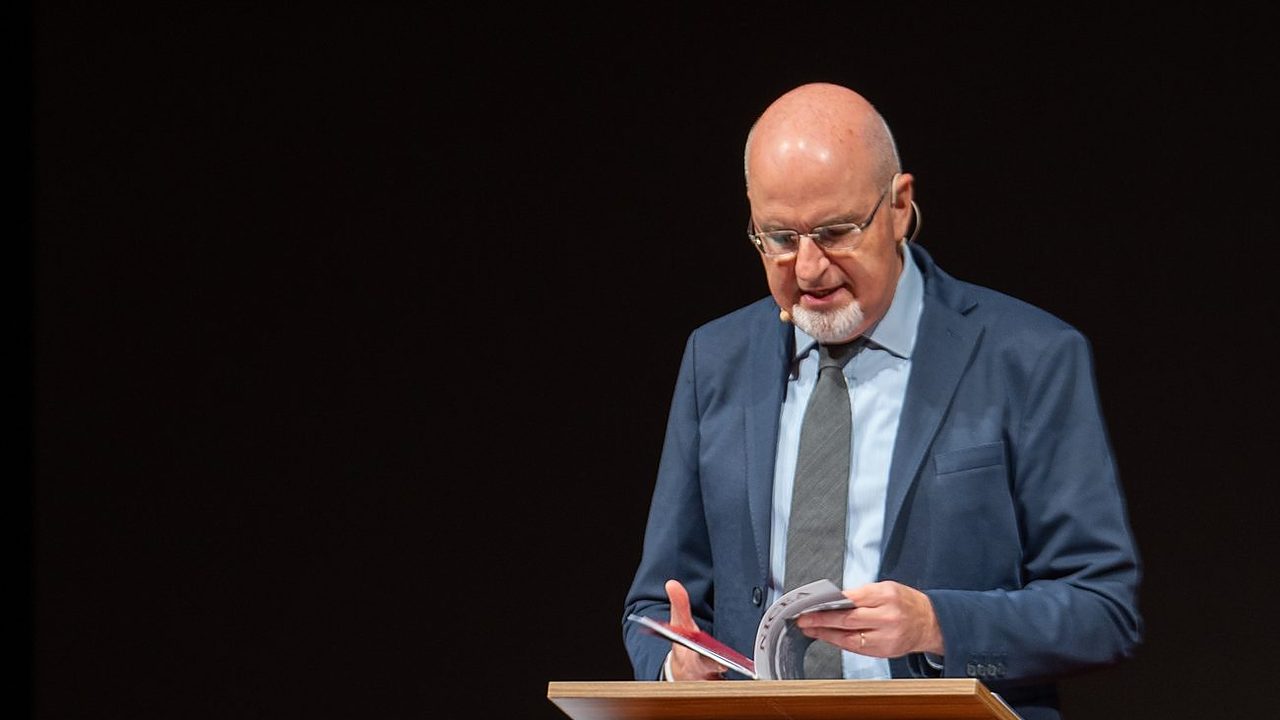
A summary of the session
Leonardo De Chirico speaks on the Creed's confession that Christ was incarnate by the Holy Spirit of the virgin Mary. This breakout session considers what the virgin birth tells us about the person of Christ, and why the church has always treated it as more than a detail.
Transcript
Leonardo De Chirico, “The virgin birth,” breakout session, Nicea Conference 2025, Istanbul.
Reading: Matthew 1
Okay, good evening. I’m reading from Matthew’s Gospel chapter 1. Reading from verses 18 to 25. Mark Matthew’s Gospel chapter 1 vers 18 to 25.
Now the birth of Jesus Christ took place in this way. When his mother Mary had been betrothed to Joseph before they came together, she was found to be with child from the Holy Spirit. And her husband Joseph being a just man and unwilling to put her to shame resolved to divorce her quietly. But as he considered these things, behold, an angel of the Lord appeared to him in a dream, saying, “Joseph, son of David, do not fear to take Mary as your wife. For that which is conceived in her is from the Holy Spirit. She will bear a son, and you shall call him, call his name Jesus, for he will save his people from their sins. All this took place to fulfill what the Lord had spoken by the prophet. Behold, the virgin shall conceive and bear a son, and they shall call his name Emmanuel, which means God with us. When Joseph woke up from sleep, he did as the angels of the Lord commanded him. He took his wife but knew her not until she had given birth to a son and he called his name Jesus. [Matthew 1:18–25]
The Nicene Creed says in the article, second part of the article concerning Jesus that he came down from heaven and was incarnate by the Holy Spirit by the Virgin Mary and was made man.
Six marks of the creed’s statement
In this presentation, I will divide what I’m going to say in two parts. In the first part, I will make some remarks on the significance of the virgin birth of Jesus and the place of Mary in the structure and the content of the creed.
In the second part of the presentation, I will briefly outline two ways in which this article or semi article have been misused or abused. One way will be through the inflation of the article making it bigger. The other way through the shrinking of this article making it insignificant.
And we will conclude by reminding ourselves of our responsibility to maintain biblical doctrine in its fullness and in its integrity. So b born of the virgin Mary. The first remark that I want to suggest is that is an historical remark. The insertion of the reference to the virgin Mary was not present in the first edition or account or version of the Nicene Creed.
We don’t find it in the 325 version of the creed which goes through the brief reference to the incarnation of the Son in the person of Jesus without making reference to his birth and therefore without making reference to Mary his mother. It was only in 381 when the creed was expanded and elaborated upon here in Constantinople that the reference to Mary and the virgin birth was inserted was added.
That is to say that as important as it is the reference to Mary as the virgin mother of Jesus, it was not part of the intentional focus of the drafters of the first version of the creed. That doesn’t mean absolutely that the insertion was wrong or was redundant. It only means that as an historical fact, the Nicene Creed that we celebrate in its original version did make reference to Jesus. Did make reference to the Son having become a man. Did make reference to the purpose of this incarnation but did not make reference to the fact of how the incarnation took place through Mary the mother of Jesus.
Secondly, this important reference to the virgin birth of Jesus is not an independent article. It is not a standing alone piece of doctrine. It is not a statement that stands on its own but is located is inserted within a framework that makes gives it its meaning.
It is a explanation of the mode of the incarnation that assumes the fact of the incarnation and wants us to confess the way in which it happened. But it’s not a Mariological doctrine that stands on its own.
It is not a, as the subsequent theologians would talk about, it is not a standalone locus of doctrine. Mary’s appearance in the creed makes reference and is given meaning within the context of what precedes that reference and what follows that reference. We cannot take it out and make it standing on its own. It is in the light of Christ and in the work by the work of the Holy Spirit that the reference to Mary is to be received.
Thirdly, the focus of this statement born of the Virgin Mary or from the Virgin Mary has a christological intent and a trinitarian framework. This is the correct context in which we have to receive what the creed says. It talks about Christ and the focus of the creed is the wonder of the incarnation of Christ, our savior, his person as it is related to his work. And in this context, the explanation of how it happened makes sense.
And the reference to Christ as our savior, the incarnate one, the God man, fully God, fully man, make sense in the context of the trinitarian broader framework. God the Father, we believe in God the Father and in the Lord Jesus, the God man who came with to us and became a man by the power of the Holy Spirit. And we believe in the Spirit. That is the framework giving sense to even this statement concerning Mary and the virgin birth.
It talks about the way in which the Son became incarnate and the way in which his humanity came through. God the Father sent the Son. The Son became incarnate and received in a way his humanity through his birth and through his mother. But the origin of that humanity as it is true of the origin of his person is from God. So the divine agency by the Spirit actively sending the Son is received passively by the human agency and then leading to the incarnation of the Son in the person of Jesus.
Fourthly, the reference here has to do with an historical fact. We’re talking about a birth. We’re talking about something that happened in the context of the space and time. We’re talking about history. We’re talking about something that happened historically. It is a literal virginity.
There was no sexual intercourse. And yet it did happen in history. We’re not talking about a story. We’re not only talking about a myth. We’re not talking about an account. We’re talking about real history. And that real historical fact is reinforced with the naming of Mary.
A real lady, an historical person carrying a real name, a Jewish lady bringing about an Jewish identity of herself and of his Son, Jesus. We’ll be seeing later on that this important remark has been questioned not only in modern times but has always been part of an ongoing discussion concerning the historicity of the virgin birth in ancient times as well as in our modern times. It is an historical fact. Jesus was born in history, in space, and in time.
Fifthly, it was a corporeal birth. We’re talking about a body that was born out of the Virgin Mary. Historically is a fact. It’s a fact. But also corporally it is a given that baby was conceived. It was an embryo. It became a fetus. It went through prenatal growth and eventually it was delivered as a body, as an embodied person.
We’re talking about a real person, a real body. And that reference wants to stress the fact that we are not talking about an angel. We’re not talking about a ghost. We’re not talking about an appearance. We are talking about a real person born out of a real mother whose name was Mary giving this boy, this man, this baby his Jewish identity.
Sixthly, we’re talking about a supernatural event. Yes, it is historical in space and time. Yes, it is corporeal talking about a body that was taken by the Lord Jesus in becoming a man. But it speaks to us of a supernatural event.
You cannot really reduce it to a the ordinary biological processes. Although this birth follows the natural processes of that leads from the embryonic state to the birth of a baby that’s biologically describable. But the origin of that conception happened in the context of a supernatural act of God.
Pren the prenatal life of the Lord Jesus happened in the context of God’s ordinary providence. God’s the Lord Jesus’s conception happened in the context of the extraordinary providence of God who chooses to conceive the Lord Jesus in the womb of Mary by a supernatural divine act through the biological processes of prenatal life leading to the delivery.
And that is another aspect that if we don’t apply biblical categories we will sooner or later end up in either overemphasizing the natural processes of biological birth without taking notice of the fact that it was initiated by a supernatural act of God. Or if we diminish the importance of human biology as it was established by God at creation, we will only look at the supernatural aspect of Jesus’s conception.
The statement here helps us to see the two agencies working together. Supernaturally conceived, naturally born. Supernatural origin, divine origin, human birth, supernatural intervention of God, historical fact. It’s both. And we enter the realm of God’s creation. And in God’s creation, God is sovereign to work ordinarily through his ordinary providence. And God is free to work in supernatural ways without him failing to be God and without him failing to be loyal to himself.
So we are given this statement as to appreciate how the world the word became flesh. In a way in a nutshell this article gives us the grammar of how the incarnation happened by the Spirit by the virgin Mary. And the reference to Mary serves the purpose of locating the birth of Jesus in history and time and at the same time presenting this person as the Son of God incarnate.
If we fail to respect this emphasis, dual emphasis coming out of the creed, we will end up in either failing to appreciate the humanity of Jesus or failing to appreciate the divinity of Jesus. This is a way to respect and honor the teaching that the council of Nicea in its further elaboration at Constantinople wanted us to retain. It is the Bible that drives the confession about Jesus having been born by the Spirit by the Virgin Mary. It is not a philosophical speculation.
It is not something of a madeup story, a mythological reconstruction. It is as the drafters of the creed interpreted the Bible, received the Bible, struggled to make sense of what the Bible was telling them. It was out of that desire to be under the authority of Scripture that this statement came out. It was not something that they invented.
It was not something that they produced in order to try to explain what was not explicable or explainable. It was their desire for the truth of the Bible, the truth of the gospel to be summarized and to become part of the larger statement about the reality of God, the Father, the Son, and the Holy Spirit having created the world and in the Lord Jesus, the Son becoming having become man becoming the savior of the world.
Two ways we abuse the statement
There are two ways in which we actually abuse the statement concerning the virgin birth. And there have been two ways in church history in which this malpractice or mispractice, misunderstanding has taken place. First by inflating the meaning, the significance of the article. Every one of us who has little acquaintance with what happens within the broad camp of Christianity, every one of us knows that whenever the reference to Mary is evoked, there are worlds that open up in people’s imagination, in people’s feelings, in people’s deep cords. Of their hearts. Mary has been inflated to a degree of becoming a standing alone reference point not only in the creed but also in people’s lives. And that happened when from taking away that reference to the virgin birth in the creed that is carefully put in the context of a christological statement within the wider framework of a trinitarian account of the gospel.
When that reference was taken out of that context, it became to grow and to expand to the point of becoming exuberant, exaggerated, self-referential, as if the focus of the gospel while being on Christ, the Son of God incarnate, needed to be expanded in order to be fully appreciated with Mary being elevated to a place that went beyond the boundaries given to us in Scripture and attested in the creed.
So Mary’s virginity came to be associated with her purity, her higher standards of holiness. And Mary’s virginity became to be seen as a virtue that would lead her would need us to consider her as full of grace, purer, holier, closer to God.
And so instead of honoring the way in which the Bible speaks about the sanctity of sex in the context of a married couple, virginity began to be considered as a superior virtue that would lead Mary to be considered as closer to God because of her virginity. You know, no longer having the Bible setting the categories and the boundaries for such a consideration, but allowing Greco Roman Hellenistic non-biblical forms of thought to begin to define the way in which her virginity needed to be appreciated.
And it is through non-canonical gospels that we have an insistent re reference to the perpetual virginity of Mary. And that led to further speculation opening up a window if not a door to the further enlargement of this Marian body of beliefs.
leading to proclaiming Marys of grace because the Lord Jesus her son needed to be received as mediator and Mary being the mother having a need to be her considered to be sharing in that mediatorship outside of biblical boundaries and in the Roman Latin Catholic tradition that Marian growth, Mariological development went as far as elevating Mary to having to be received and believed as if he were she were immaculately conceived.
That is the 1854 dogma of the immaculate conception. You see we are talking we began by looking at Mary’s virginity and role in the incarnation of Christ without biblical boundaries. It expanded over as to then imply a purer character of Mary to the point of having to wait 18 centuries before the church would then define a dogma of Mary’s immaculate conception. The idea that she was preserved from original sin from her con conception. So what needed to be ascribed to Jesus was stretched as to include the mother.
And so the biblical christological trinitarian boundaries of the creed were broken to open up an highway that would instead elevate Mary to a position that the creed is not suggesting. And that development went as far as the latest dogma proclaimed by Rome, the 1950 dogma of Mary’s bodily assumption. The idea that as soon as she died, she was taken body and earth, body and soul to the heavenly glories to share the glory with the Son.
You see the development from the virgin birth not carefully guarded within biblical boundaries. That assertion, profession of faith with a Mariological tone grew and grew to the point of becoming an inflated view of Mary way belong or beyond biblical boundaries.
That is not the way to honor the council of Nicea and the creed that came out of that council. In today’s celebration and appreciation of the creed, as we say that Jesus was conceived of the Virgin Mary, we not only have to repeat this and appropriate this, but we also have to go back to the biblical framework that from which it stemmed.
Otherwise we assume that this statement took an independent route and developed over time resulting in a statement Mariological statement that is far removed from the intentions of the creed the letter and the Spirit of the Nicene Creed.
The second abuse
But there was another abuse that the statement about Mary’s role in the incarnation of the Son took form. There is another deviation. If one deviation had to do with the inflation of the article, the other deviation was about his the shrinking of the article, the diminishing of the article, the undermining of the article, the elimination of the article, the questioning of the article. You see two opposite extremes. One an inflation an explosion of Mariological devotions and doctrine to the point of becoming dogmas. On the other hand, the willingness to downplay and to crush and to if possible eradicate the virgin birth from Christianity and the profession of the Christian faith. That was not it’s not a modern attempt.
It was an ancient attempt too that the council or the generations after the council had to deal with and various hypothesis and accounts of how this birth took place originated not only in modernity but also in ancient time.
The virgin birth in modernity
In modernity in particular, this very aspect of the creed was subject to scrutiny and in the attempt of undermining its credibility, undermining the historicity, undermining the supernatural nature of the event, undermining the descriptive nature of that statement. Wanting to talk about that reference to the virgin birth as a madeup story, a an attempt of explaining what the ancient men could not explain in other terms other than making reference to miracles. And since modernity at least one strand of it could not believe in miracles as an a priori as an assumption as a presupposition. Therefore, since we haven’t had any other man having born out of a virgin without a sexual intercourse, that was in principle excluded from it being a truthful statement happened in history.
Other attempts tried to give it a poetic nature as if these ancient people reading the Bible didn’t have access to scientific language and methods and therefore came up with this statement out of their poetic imagination. No other way was possible for them to explain it. And so they refer to this talk of Mary’s Jesus’s virgin Mary, Jesus’s birth out of the Virgin Mary. And much of contemporary theology retains doubts on the fundamental traits of this article. The historicity, the supernatural event, the combination of extraordinary and ordinary providence together in the miracle of Jesus’s incarnation as it is explained to us in the creed.
It was in 1930 that Gresham Machen wrote an important book on the virgin birth because at the very beginning of the 20th century, the virgin birth was subject to severe criticism coming from different strands of liberal theology, urging Christians to erase that article because of its unbelievability. And therefore, man took the challenge of defending the biblical truth of the virgin birth of Christ.
And his desire was to honor the teaching of Scripture whereby in the fullness of time, God sent his Son born of a woman to be the one in whom we should find salvation. In him, a new beginning for the human race happened. The new Adam came to us. In the first Adam, we received a sinful nature. Through the second Adam, born of a virgin from God of God, light of light, incarnate in history in time through the Virgin Mary, we receive the new Adam in whom we have hope to be saved. If we confess his person and work and we receive his salvation, we are not self-sufficient as human beings, but we need desperately need God’s grace working miraculously. And in a way, the virgin birth of Jesus in its miraculous aspects is an analogy of what happens in our new birth.
We cannot produce it although we embody it. It doesn’t come from us although we experience it. It comes from heaven although it we receive it in our space and time. We need God’s grace to be saved. We need a miracle to happen to be initiated into the new life. We are not waiting for angels to give the salvation that we need. We need God himself through his son incarnate and his spirit who will reveal to us his way of salvation and who will work in us the miracle of regeneration.
What we confess
So we believe in as the Nicene Creed says we believe that the Lord Jesus came down from heaven was incarnate by the Holy Spirit by the Virgin Mary and was made man. And as we receive this statement we make it our own. We want to nourish it under, with, and through the Bible. We don’t want to over expand it beyond what the Bible tells us. We don’t want to diminish it in a way that the Bible prevents us. We want to maintain it according to Scriptures and to profess it in our own generation. Let’s pray.
Prayer
Father God, thank you for sending your son and for letting the Spirit conceive in the womb of Mary, the Lord Jesus, our savior and lord. We thank you because you chose this miraculous way to make the point that our salvation doesn’t come out of us but is a gift that is received from you. And yet we thank you Lord because this salvation encounters us where we are.
You’re not expecting us to move beyond our humanity, beyond our bodily existence. You meet with us as people and you regenerate us as new men and women, as a new people of God to serve your glorious purposes for our lives and for the world. We pray Lord as we confess and defend the virgin birth of Jesus through the womb of Mary, we pray that we might be faithful to guard this doctrine and to make it our own for the glory of the Lord Jesus, our savior. In whose name we pray, amen.
Keep going
More sessions






